- הרשמה לניוזלטר
- מועדון המשפיעים
- שימושון
- אודות
- תרום לנו
- צור קשר

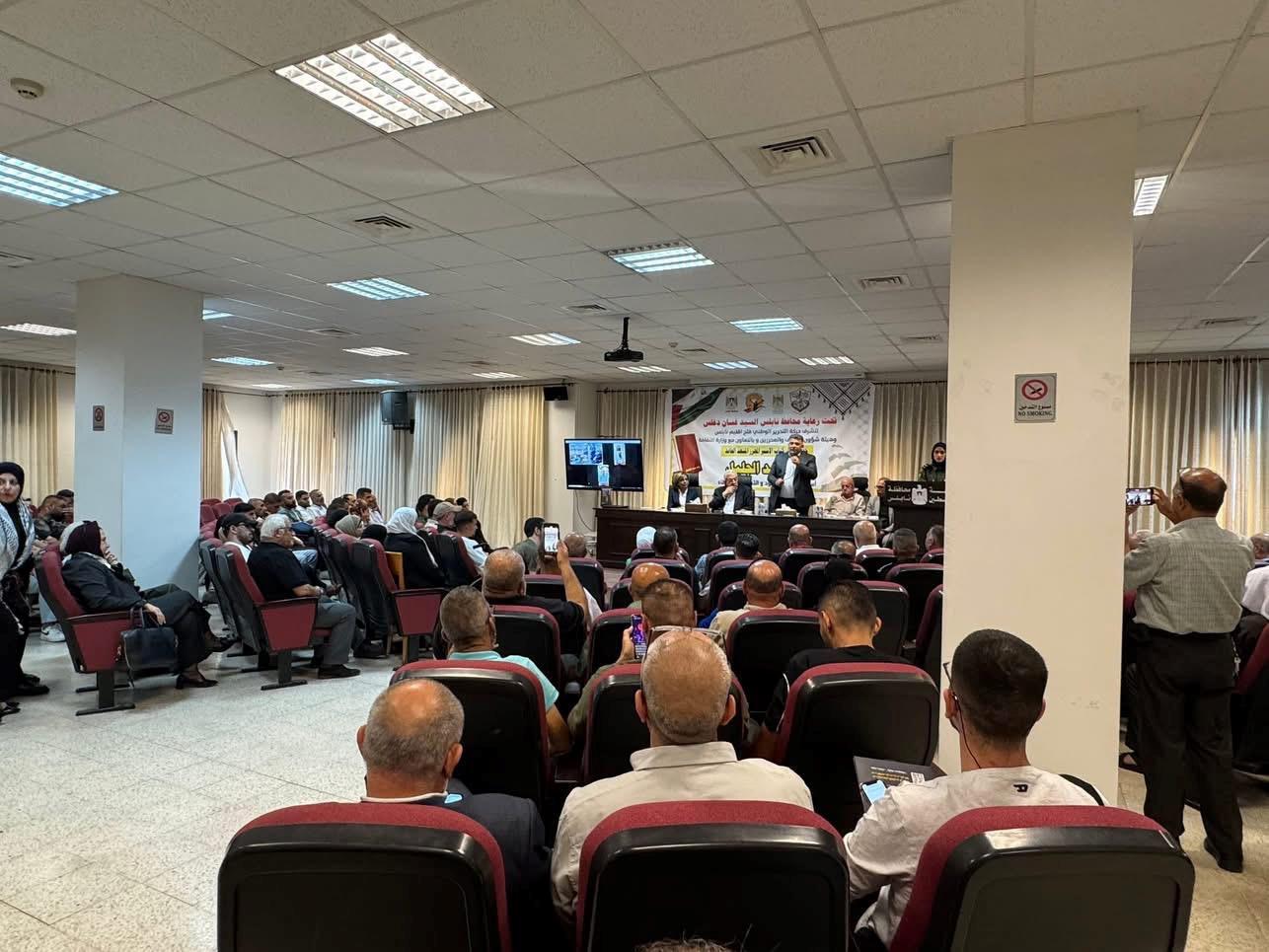
The ceremony, attended by Nablus Governor Assan Douglas and Mahmoud Al‑Aloul, deputy to Mahmoud Abbas in the Fatah movement, as well as other senior Fatah figures, honored Raed Abd al‑Jalil — a released terrorist who was responsible for dispatching and supplying the explosive belt and weapon to the terrorist who executed the May 2002 massacre at the Hitzim yeshiva in Itamar.
A commemorative plaque and certificate of appreciation were awarded to the terrorist’s family. The certificate bore a map that included the entire territory of the State of Israel. Abd al‑Jalil himself, deported from Israel, addressed the audience through video.
Raed Abd al‑Jalil, from the village of Beit Dajan near Nablus, described in an interview following his release that during the Intifada he worked in the fire department in Nablus. Yet, as he himself admitted, his “real life” was filled with political and militant activity within the ranks of Fatah — particularly in the al‑Aqsa Martyrs Brigades, the movement’s military arm, “since its founding.”
He recounted his involvement in the military wing of Fatah, where he organized summer camps for youth, which he openly characterized as “a source of support for the resistance.” He also oversaw Fatah‑sponsored activities in schools. His direct commander was terrorist Yasser Abu Bakr, convicted of murdering a baby girl. Abu Bakr himself was released in the most recent prisoner exchange — not deported — and was honored with official ceremonies by the Palestinian Authority.
Raed Abd al‑Jalil also described the change in prison conditions after October 7, which he characterized as “a transition from prison to hell.” During his incarceration he completed both a bachelor’s and master’s degree and authored several books. Among them is the newly launched “Love and a Rifle”, which focuses on the figure of terrorist Rami Nur, his partner in the al‑Aqsa Martyrs Brigades, who carried out a shooting attack in the Neve Yaakov neighborhood in which nine people were wounded, four of them seriously. Abd al‑Jalil also wrote numerous other books dealing with the biographies of Fatah terrorists.
An additional revealing anecdote he shared was his time in prison alongside Amir Makhoul — a member of the Higher Arab Monitoring Committee in Israel who was convicted of spying for Hezbollah and sentenced to nine years in prison. Abd al‑Jalil described Makhoul as someone “who pushed us toward writing and learning.” Today, the released spy Amir Makhoul — who before his arrest headed the umbrella organization of Arab NGOs in Israel — is running for the position of chairman of the Higher Arab Monitoring Committee.