- הרשמה לניוזלטר
- מועדון המשפיעים
- שימושון
- אודות
- תרום לנו
- צור קשר

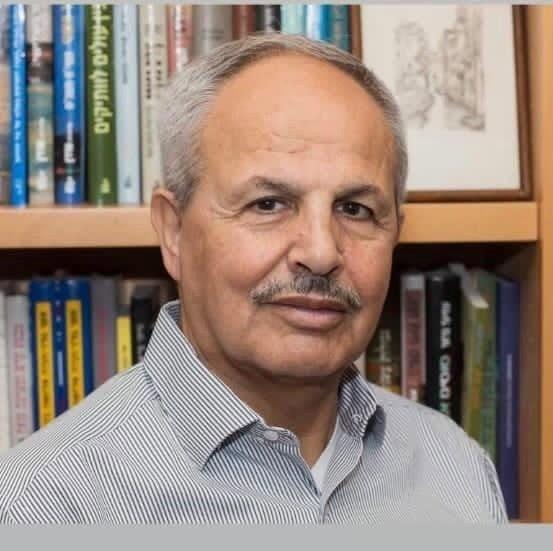
Through sophistication, persistence, leverage of civil rights rhetoric, and relentless work inside the state’s own apparatus, Professor Rassem Khamaisi is driving a process that creates massive Arab continuous corridors across the Galilee—fueled by overt nationalist and Islamist ambitions.
How did the Israeli planning and building establishment transform into a potent weapon in the hands of Arab nationalist elements? How can a single individual—operating through government ministries, official committees, and academia—promote processes designed to redraw the demographic and strategic map of Israel?
In this comprehensive investigation, we expose the true face of Prof. Rassem Khamaisi: not merely an urban planner, but the architect of a religious and nationalist struggle who exploits the mechanisms of the state to reshape the Galilee in a manner that poses an existential threat to the State of Israel.
This map tells the grim story of the Galilee, illustrating exactly how the region will look in just a few short years if the State of Israel does not wake up and take drastic action.
From a time when the State of Israel and its institutions championed the vital goal of Judaizing the Galilee in order to interrupt contiguous Arab settlement, the map shows how Israel’s own planning authorities have become a primary tool for turning vast swaths of the Galilee into Arab corridors that suffocate tiny, isolated Jewish enclaves.
The map, produced by the "Lev BaGalil" organization, outlines the municipal boundaries of Arab localities in the Galilee following the expansions of recent years. In many of them, comprehensive and additional master plans have already been approved, while other plans remain at various stages of the approval pipeline.
These plans lay out virtually completely contiguous Arab corridors across the length and breadth of the Galilee, establishing a strategic threat of the highest order. In the event of an all-out war joined by Israeli-Arab citizens, these corridors would enable the northern part of the country to be severed from its center within minutes.
Take, for example, the line between Migdal, adjacent to the Sea of Galilee in the east, and Kiryat Yam in the west. An area of contiguous Arab settlement spans the entire center of the Galilee. Less than 10 kilometers on either side is all it takes to totally cut off the Galilee. On the Migdal side, it is a matter of controlling a single road descending to the Sea of Galilee area.
During the riots of 5781 (2021) amid Operation "Guardians of the Walls," Arab rioters blocked numerous roads, including the Misgav junction in the heart of the Galilee—effectively cutting off the Misgav bloc and placing settlements under siege. Under current conditions, Israel could be split in two within minutes along the Kinneret–Krayot axis, which is already an almost complete contiguous Arab bloc.
In many of the municipal plans that comprise this map, one can trace the fingerprints of a key figure: Professor Rassem Khamaisi. But to understand how we arrived at this point, and Khamaisi’s specific role in the process, we must look back a bit into the past.
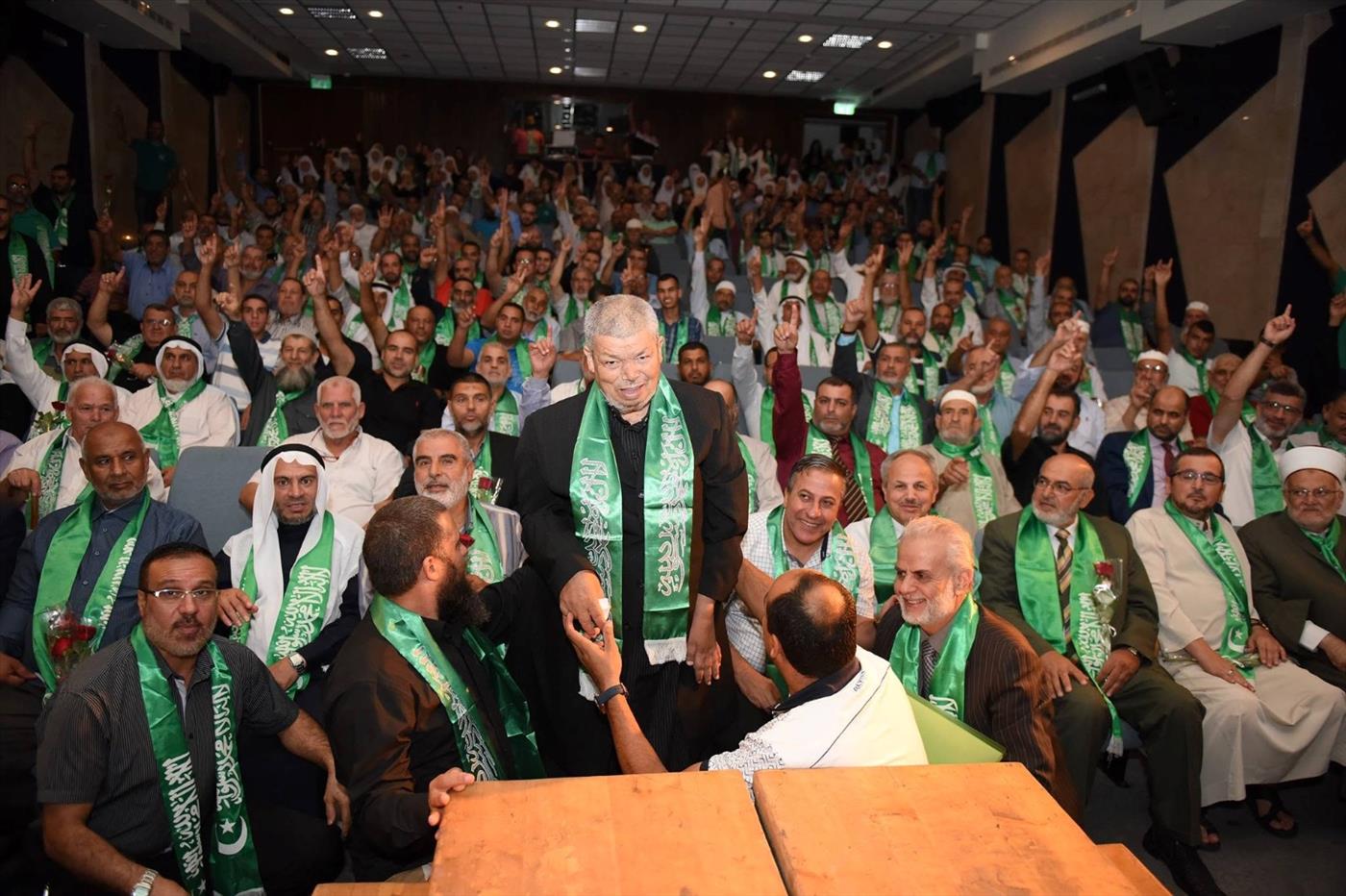
Immediately following the War of Independence began the struggle over land between state authorities and Israeli Arabs—many of whom refer to themselves as "Palestinians" or "the Arabs on the inside".
The IDF liberated the heart of the Galilee, an area that under the Partition Plan was designated for the most part to be included in the Arab state.
Many Galilee Arabs who took part in the fighting alongside hostile gangs fled, leaving numerous Arab localities abandoned. Some fled beyond the borders of the State of Israel. They are referred to even today by the Arab propaganda machine as "refugees". Others settled in towns inside the State of Israel, and were referred to by Arabs as "displaced persons."
For many years, the State of Israel operated openly to "Judaize the Galilee." To secure a Jewish majority in the Galilee, Jewish communities were built on many of the abandoned enemy villages. In the 1950s, as part of David Ben-Gurion’s plan to Judaize the Galilee, the state established Migdal HaEmek and Upper Nazareth, followed in the early 1960s by Carmiel, for whose construction lands were expropriated. Toward the end of the 1970s, Ariel Sharon initiated the "Mitzpim (Lookouts) Plan", under which a large number of small Jewish communities were established in a short timeframe to create contiguous Jewish zones and form a buffer between Arab localities.
In the "Palestinian" myth, the first generation of Israeli Arabs who lived through the "Nakba" was dubbed the "Generation of Survivors." Their strength lay in their continued clinging to the land and surviving the Nakba.
This generation focused on preserving the consciousness of the "Right of Return"—both for refugees who left the state’s territory and for the return to the lands of those displaced villages. Under this narrative, the entire Galilee is Arab land.
In this spirit, the "Arab Committee for the Defense of Land" was established in 1975, initiating riots one year later that came to be known as "Land Day."
These riots broke out in response to the first Rabin government’s decision to expropriate lands from Sakhnin for the benefit of the city of Carmiel. Land Day served as a pivotal turning point in the Israeli-Arab struggle over land and in their national consciousness—and ultimately, in how state authorities handled the issue.
In contrast to the state's past attempts to act in a Zionist spirit to "Judaize the Galilee," opposing trends began to take hold.
Parallel to the Oslo process, a similar process commenced in the 1990s within the borders of "Little Israel." The concept of Judaizing the Galilee was suddenly perceived as racist, leading state authorities to dismiss Judaization as irrelevant to the planning process.
At the same time, an accelerated campaign of Arab takeover of open lands as well as illegal Arab construction surged across the Negev and Galilee.
The High Follow-Up Committee for Arab Citizens of Israel and Arab municipal leaders repeatedly exploited state enforcement actions, casting every law enforcement measure as a nationalist struggle over land. At the same time, they advanced the claim that illegal construction stemmed from a lack of planning.
These trends reached a climax in the findings of the Or Commission, appointed following the October 2000 riots, in which Israeli Arab citizens joined in the violence that launched the Second Intifada.
The Or Commission asserted that "the state did not do enough, nor did it exert sufficient effort, to ensure equality for its Arab citizens and to eliminate discrimination and inequality." In its conclusions, the commission called for "vigorous systemic action that will provide a real response to the issue of home demolitions and expropriations," instead of what it termed "decisions whose reasonableness is dubious and which reflect a lack of sensitivity."
This new reality, in which planning authorities were called to the flag not to Judaize the Galilee, but to develop Arab localities—completed a total paradigm shift within the bureaucratic ranks. In place of Judaizing the Galilee, affirmative action for Arabs developed alongside draconian demands imposed on Jews.
In 2015, TheMarker reporter Merav Arlosoroff published an article titled: "67 Years Late – The End of the Era of Judaizing the Galilee."
A key example Arlosoroff cited was the establishment of an inter-ministerial team that "proposes transferring land planning control to Arabs by increasing the number of local planning committees controlled by Arab councils."
Another significant pillar was Resolution 922 regarding "Government Action for Economic Development in the Minority Population for 2016–2020," adopted in December 2015 by the Netanyahu government.
This was a revolutionary decision that mandated the completion of updated master plans for all Arab localities with over 5,000 residents, removing barriers to building additional housing units, and providing "after-the-fact planning" to legalize existing neighborhoods and homes.
Furthermore, the creation of the VATMAL (National Planning and Building Committee for Preferred Housing Complexes) in July 2014 enabled the advancement of large-scale, rapid, and flexible planning in Arab localities across the north.
Alongside this process, more and more Arab planning personnel entered state planning authorities, particularly following published studies that alleged "discrimination" and protested the lack of appropriate Arab representation within planning institutions.
Is this merely natural growth and the civil needs of Israeli Arab citizens, and nothing more? Or is there a coherent Islamist-nationalist ideology driving Arab expansion in the Galilee? This question deeply concerns many, and in this investigation, we intend to present the answer.
On January 14, 2017, the High Follow-Up Committee for Arab Citizens of Israel convened for an in-depth discussion aimed at formulating a strategic plan regarding land and housing.
The background: the destruction of houses by Israeli authorities attempting to confront the epidemic of illegal Arab construction, an unusually large enforcement action in which eleven illegal structures in Qalansawe were demolished, and the legislative process of the Kaminitz Law, designed to provide authorities with effective tools to combat illegal building.
The objective of the meeting—establishing a permanent body to deal with land and housing matters on behalf of the High Follow-Up Committee.
The meeting, held at the Ar'ara Local Council building, was attended by members of the High Follow-Up Committee—dozens of Arab public leaders in the State of Israel—with the goal of formulating a plan that would combine a struggle within the planning institutions alongside a struggle on the ground, a media campaign, and even an international struggle against the State of Israel and its policies.
A statement issued by the High Follow-Up Committee following the discussion expressed their basic premise: the planning and building laws are a continuation of the persecution of the Arab public since the "Nakba" and the establishment of the State of Israel, as part of a national struggle for control over land , which in their view belongs entirely to the Arabs.
During the discussion, the individual who laid out a detailed ideological plan together with a sophisticated strategy was Prof. Rassem Khamaisi—the "guru" of Arab planning in Israel.
In a Facebook post, Khamaisi shared a lengthy text detailing the theory behind his life's work, outlining the processes and phases for using terminology and the government system to advance "Palestinian national" and Islamist objectives—specifically from within the planning committees of the Israeli establishment. This text, along with another long post he published in 2018, can be viewed as the presentation of a coherent operational plan by Khamaisi, according to which he actively operates.
Thus, Khamaisi defined the struggle over land as "Ribat" (an Islamic concept meaning the defense of Islamic land in preparation for war) toward a "comprehensive national project."
Writing in a rich language that weaves professional terms from the planning world with academic terminology, Khamaisi presents a sophisticated blueprint grounded in an ideology that views Israeli Arab citizens as the "Palestinian" rightful owners of the land, adheres to the Right of Return, and advocates carrying out Ribat across all of Israel.
In his words, "the allocation of suitable land for development in Arab cities, neighborhoods, and villages is fundamental to the continued existence and development of Arab society in the homeland." Khamaisi notes that despite the Zionist movement's ambition for "complete dominance over land ownership in the country... there exist areas of opportunity that allow us to intervene and advance our civil rights—without relinquishing our national rights."
Distributive Justice, Transitional Justice, and the National Narrative
Khamaisi advocates using the terms "distributive justice" and "transitional justice," and adopting a language of "realizing rights"—without abandoning the national narrative for a single second.
Specifically, he leans heavily on the terms "distributive justice" (an equal outcome distribution, without regard to root causes), "transitional justice" (the mechanism used, for example, in transitioning from war to peace), and "corrective justice" (compensating for alleged past wrongs). These three concepts—borrowed directly from post-colonial theory to paint Zionism as a dispossessing colonial enterprise—are regularly weaponized by the Left to rationalize affirmative discrimination in favor of groups crowned as "oppressed."
Furthermore, Khamaisi routinely uses the phrase "village lands," while clutching maps of Arab villages from prior to the 1948 Nakba.
To this end, he proposes focusing on three spheres: designating land ownership—demanding, for instance, that the state recognize Bedouin ownership claims over Negev lands; demanding the return of lands to "displaced persons" through the expansion of Arab municipal boundaries; and establishing independent local planning committees.
Khamaisi calls on Arab citizens to take initiative and reclaim lands by working through the state’s own institutions: "We must transcend the discriminatory language and order imposed by state policy, by way of conscious, responsible, and assertive participation in the planning process, even with regard to lands outside of Arab municipal boundaries—because this is the domain of our living space and influence. This participation is part of exercising active citizenship, and it does not inherently confer legitimacy on a historical injustice; on the contrary—it is a vehicle to expose it, address it, and diminish it."
In the planning realm, Khamaisi demands an internal transformation to instill an intra-Arab societal culture of planning:
"Planning must not be entrusted solely to state institutions; the initiative to prepare plans must rest with local authorities and the community itself. Our struggle against establishment policy should not divert us from building and managing our own institutions (primarily local authorities and civil society), while simultaneously confronting discriminatory policy. We must adopt a strategy centered on moving from a culture of reaction and protest to a culture of initiative, action, and conscious participation—both vis-à-vis the state and in building our own community."
Toward the end of the document, Khamaisi lays out a series of practical recommendations that harness civil rights rhetoric to maximize land control. Among his recommendations: halting all demolitions and creating a public authority with Arab representatives to formulate a roadmap for legalizing and retroactively authorizing the illegal construction spree; preparing comprehensive master plans and establishing local planning committees; and returning Waqf lands to the control of an Arab-Muslim entity.
In another article published by Khamaisi in July 2018, he calls upon Arabs to learn from the Zionist movement, to move from what he terms the "temporary" status, and to plan toward a "permanent" status:
"The thought process of the Zionist movement involved planning long before the establishment of the state—through proactive, bottom-up planning—and placing efficient governing institutions at its disposal."
According to Khamaisi, the transition from the Nakba generation to the "Proud Generation," which seeks to realize its full citizenship, requires shedding the "temporary status" mindset. He describes this mindset as a deliberately constructed and entrenched consciousness that prevents Palestinians in Israel from viewing themselves as the owners and rightful landlords with complete rights and responsibilities.
In his view, this condition undermines their capacity to actively plan their own future. "Remaining in a temporary status compels us to act like unprotected tenants, even though we are the landlords," he wrote.
He argues that an opportunity now exists to exploit state institutions to advance these very objectives:
"In recent years, reforms have been effected in the establishment's policies and planning mechanisms, opening opportunities for local planning initiatives—both individual and collective—alongside the development of planning consciousness and practice to shape our environment according to our needs, and to foster a planning mindset and awareness."
The articles authored by Khamaisi outline an operational plan derived from a cohesive ideology aimed at advancing nationalist goals: preserving and entrenching the existence, identity, and future of the "Palestinian people in their homeland" while confronting challenges and oppression through civil rights rhetoric, including from within state institutions. To this end, Khamaisi calls on the leadership of Arab society to adopt civil rights rhetoric, to transition from a 'temporary' model to structured planning, and to assertively exercise the rights conferred by Israeli citizenship—which, in his view, demands no concession on any nationalist principles.
Indeed, that exact planning strategy presented by Khamaisi at the High Follow-Up Committee meeting has been manifested in extensive planning activity. The result: a significant expansion of Arab municipal boundaries in the north, the creation of contiguous areas of Arab settlement, and control over strategic highways. All of this operates on two levels: both in fundamental principles embedded into the planning process, and in dozens of local master plans advanced across various stages.
Born in 1958 and residing in Kafr Kanna, Khamaisi is widely regarded as the "guru" of the Arab planning world in Israel. In interviews, he says that he has been engaged in urban planning since graduating in 1985. He enjoys revered status in academia, and the strategic blueprint he presented to the "High Follow-Up Committee for Arab Citizens of Israel" in 2017 vividly illustrates how academic terminology is deployed as a cover to advance anti-Zionist objectives—and highlights the existential danger embedded in this strategy.
Khamaisi holds a bachelor's degree in geography from Ben-Gurion University, a master's degree in urban planning from the Technion, and a doctorate in geography from the Hebrew University. He completed post-doctoral research at the London School of Economics (LSE) and Queen Mary University of London.
Since 1996, he has lectured at the University of Haifa, where he was appointed associate professor in the Department of Geography and Environmental Studies in 2013. He holds various academic and public positions and sits on numerous planning committees. In 2012, he was awarded the title "Distinguished Planner of Israel" by the Israel Planning Association.
In an official publication by the Ministry of Science and Technology, he was described as "one of the dominant urban planners in Arab towns within the State of Israel, as well as in the territories of the Palestinian Authority. He leads counter‑planning, challenging and alternative planning, advises local authorities and public and private entities on urban and strategic planning and management, and has participated in planning teams for national, regional, and local master plans."
Today, Khamaisi heads a private planning firm named CPS – 'The Center for Planning and Studies' in Kafr Kanna, established as a private company in 2019 and registered in 2024 as a public benefit company. In this capacity, he also served as an advisor on Government Resolutions 550 and 918. He serves as a board member of the Association of Arab Engineers.
Concurrently, Khamaisi is politically and ideologically active. He is a member of the Islamic Movement, having served as a member of its political bureau since at least 2016, as well as a board member of the Al-Aqsa Association. His rhetoric in Arabic is continuously peppered with Islamic maxims and expressions.
In 2019, Khamaisi ran for the top spot on the United Arab List (Ra'am—the political wing of the Southern Branch of the Islamic Movement), losing to Mansour Abbas, who went on to become Ra'am's chairman. He even participated in a delegation of party representatives that met with Israeli President Isaac Herzog.
Khamaisi has been active for many years in campaigns to retroactively legalize illegal Arab construction. He is one of the founders of "The Association of Forty," established in 1988 (marking 40 years since the War of Independence) to advocate for the "recognition of unrecognized Arab villages", an organization that, along with the New Israel Fund, ultimately led to the retroactive authorization of numerous Arab localities in the north.
Throughout the years, Khamaisi has emphasized his doctrine: planning tools must be used as an opposition to Zionism, based on a worldview that Arabs are the rightful landlords.
He frequently rails against initiatives aimed at Judaizing the Negev, the Galilee, and Jerusalem. Among other declarations, he asserted that "Israeli urban planning in the occupied city of Jerusalem serves as a tool of control" against "Palestinian" efforts, while lamenting that "unfortunately, our planning consciousness as an Arab-Palestinian society remains severely insufficient."
In various contexts, Khamaisi places heavy emphasis on using language and concepts which do not accept what he labels "Zionist dictates."
In 2013, Khamaisi attended a conference on Jerusalem hosted by the "Jordanian Engineers Association"—an entity dominated by Hamas. In an interview following the event, he recounted how he called at the conference to "develop a city of steadfast defense (Ribat) and of an Arab-Palestinian presence."
At a 2016 gathering of the political bureau of the Islamic Movement, Khamaisi spoke on "the necessity of correctly understanding reality without falling under the influence of Zionist concepts and its project of Judaizing the land and the people." He underscored the imperative of "production, creativity, planning, and development from a position of strength, as a society possessing native rights in this land."
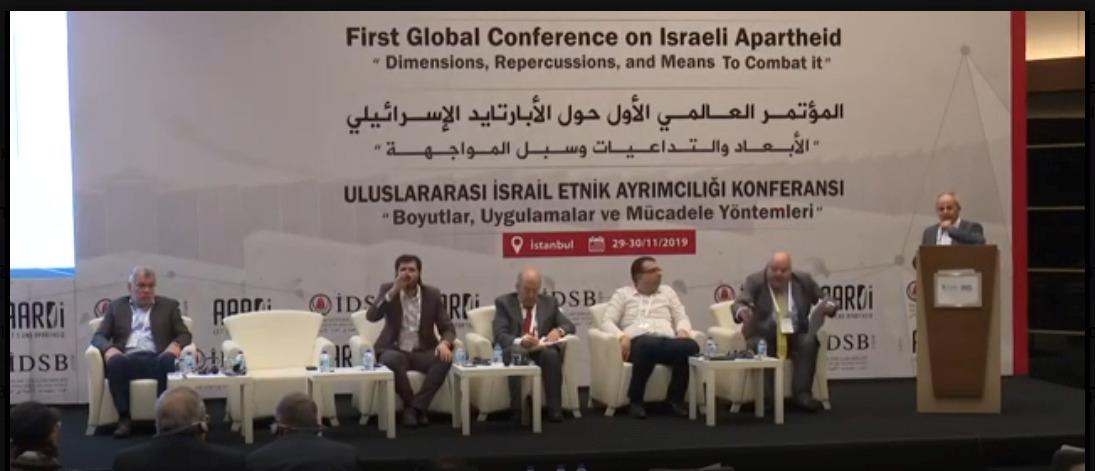
In 2019, Khamaisi participated in the 'First Global Conference on Israeli Apartheid' in Turkey. The event was organized by AARDI, an entity that openly declares that even an Israeli withdrawal behind the Green Line will not suffice, as its "fundamental problem" remains the very existence of a Jewish nation-state.
The keynote speaker at the conference—who at its conclusion read out the declaration on behalf of all participants committing to the 'dismantling of Israeli apartheid' via BDS and other channels—was Richard Falk: a notoriously self-hating Jewish-American whose rhetoric is so extreme that it has alienated even avowed enemies of Israel. Beyond the UK, which repeatedly condemned him, even a Jewish BDS group in the UK denounced him, and the Palestinian Authority itself demanded his dismissal from the UN.
In Khamaisi's own lecture at the event, he accused Israel of apartheid, alleging the construction of a "sophisticated matrix of control" over Arabs designed to forge a "distorted identity" by applying the label 'Israeli Arabs'—whom he insists on calling "Palestinians inside Palestine"—and subjecting Arabs to "psychological preparation" for emigration or displacement. In this lecture as well, Khamaisi called for proactive Palestinian strategic planning.
In a November 2016 interview with the Musawa channel before an audience of high school students from the Galilee village of Reineh, Khamaisi reviewed his doctrine at length. An example he brought from the village of Ein Hawd on the Carmel ridge illustrates his actions and objectives in the clearest possible manner.
Ein Hawd is a village that fought against Jews for nearly a century. As far back as the Great Arab Revolt in 1938, villagers participated in the kidnapping and murder of the Lazarovich-Kirzhner family from the Atlit detention camp. During the War of Independence, Haganah forces captured the village and its residents fled. Village lands were declared absentee property and handed over to local kibbutzim. In 1953, the artists' village of Ein Hod was established atop the abandoned village homes. Some residents tried to return but were denied entry, subsequently founding an illegal village nearby. In 2005, following a prolonged struggle in which Khamaisi was directly involved, the village was officially recognized. For Khamaisi, this was a crowning achievement embodying his life's mission to restore the villages destroyed during the War of Independence.
"In fact, some residents of Ein Hawd lived on their private land and faced deportation, but praise be to Allah, it [the village] was recognized, exists, and the Abu al-Hijaa family lives in it, as part of what I call 'the resumption of presence' (Isti'naf al-Wujud). Every plight that I handle I call 'challenging, resistance planning' (Takhtit Muqawim Mutahaddi) that generates a new set of tools. I do this in the West Bank for Palestinian villages, in the Negev, and in the Galilee," he declared.
One of the students present pressed Khamaisi, asking how he confronts the Kaminitz Law and the plan to Judaize the Galilee and the Negev. "Where are you and what is your role, what are you proposing, what is the alternative?" he asked.
Khamaisi replied: "I, as Rassem—a university lecturer, a planner—engage in education and outreach, I work on plans termed 'Muqawama' [meaning resistance/struggle/militancy], I initiate new ideas, and when I look at the timeline, the situation has shifted. Anyone who thinks the situation remains static, as it was in the sixties and eighties—today there is awareness, there is democratization, the localities have expanded."
Indeed, if in 2016 Khamaisi could already point to the changes he generated, a decade later, his new ideas have been embedded into virtually every relevant planning authority, producing far-reaching consequences.
Over the years, Khamaisi has also served as a planner on behalf of the Palestinian Authority for a series of strategic projects in Judea and Samaria in Area C—particularly in areas adjacent to the Green Line on one side and the Jordan Valley on the other.
In an interview with the Ehna channel at the end of 2022, Khamaisi revealed that he had prepared plans for 120 Arab villages in Area C to create facts on the ground. "I attempted to create plans for more than 120 villages so they would become permanent, recognized, grow and develop, and to expand Arab cities and villages in Area C," he said.
According to him, the figure who blocked these plans was Bezalel Smotrich. "Smotrich is responsible for the ministry, he holds authority and responsibility over the Higher Planning Council..."
However, over the years, several plans advanced by Khamaisi in Judea and Samaria were indeed approved, and their strategic consequences were immediately apparent.
For instance, in 2010 Khamaisi submitted a master plan for the village of At-Tuwani in the southern Hebron Hills. The approved plan retroactively authorized widespread illegal construction and strengthened the village—which is a source of substantial violence against neighboring Jewish communities and serves as a critical connection between the Hebron Hills and the Negev.
In 2015, Khamaisi presented a plan to retroactively authorize extensive illegal construction in the villages of Al-Uqban and Al-Muruj adjacent to Herodium. Both villages threaten to sever the arterial highway leading from Jerusalem to eastern Gush Etzion—a road that was already re-routed once to bypass Za'atara. A concerted campaign by the Regavim movement and right-wing activists succeeded in stalling the plan.
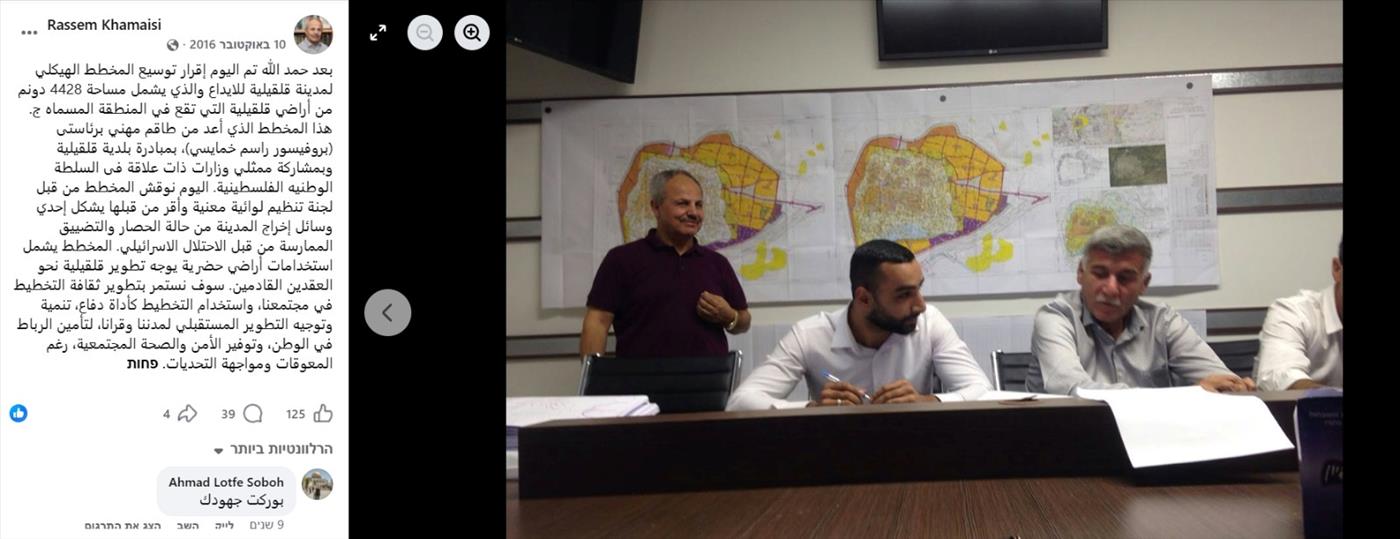
In 2016, Khamaisi's master plan to expand Qalqilya at the expense of Area C was approved for deposit, a plan that was subsequently halted by the political leadership. The scheme encompassed 14,000 housing units, which would have transformed Qalqilya—directly abutting Kfar Saba and Highway 6—into a massive urban hub. In a triumphant Facebook post, Khamaisi wrote that this was a step toward liberating Qalqilya from the "siege and restrictions imposed by the Israeli occupation," calling for the continued utilization of planning as a shield and for Ribat over the "homeland."
"This plan constitutes one of the means to liberate the city from the siege and oppression enacted by the Israeli occupation," he wrote. "...We will continue to cultivate a planning culture in our society, utilizing planning as a tool for defense, development, and guiding the future trajectory of our cities and villages, to guarantee Ribat in our homeland."
He is likewise involved in planning schemes for villages adjacent to the separation fence stretching from the Jenin area towards Um al-Fahm, Bedouin villages in the Judean Desert, communities in the Jordan Valley, and beyond.
In 2024, Khamaisi participated in the "2nd Palestine Forum" held in Qatar under the auspices of the "Arab Center for Research and Policy Studies," directed by Azmi Bishara—former Knesset member and fugitive spy. In his lecture, he painted Israel as a "colonizing state" and detailed his operations under "resistant planning" to develop Arab localities in Area C of Judea and Samaria.
Khamaisi boasted of his successes, citing the village of Dkeika, positioned at a strategic point between the Hebron Hills and the Negev. "I know every single village," he said. "When I look at a village like Dkeika, where construction was forbidden and they wanted to evict them... within two months from the moment Israel approved and allowed its recognition, roughly forty tin shacks were transformed into stone structures." "Some 250 villages extend into Area C. Today I am planning Ramallah, and it is expanding into Area C; Qalqilya, 3,448 dunams in Area C…."
In truth, Khamaisi's worldview rests on a pragmatic approach, believing that the effective path to securing achievements is through "political participation and presence." The core objective is leveraging civil rights rhetoric and tools to preserve the "Arab-Palestinian" presence, practicing "the art of the possible," and exploiting "the power of the weak"—meaning the exploitation of leverage available to the weaker party on the international stage, using legal battles to wear down the stronger party, etc.
Khamaisi repeatedly addresses Israeli Arab citizens, explaining his methodology of clinging to the homeland (Palestine) while using tools available in the State of Israel—despite uncompromising opposition to the state and grounded in the doctrine that "we are the landlords." Through this approach, he persuades them to take part in large-scale planning that effectively expands Arab territorial dominance across various regions.
The operational pattern outlined by Khamaisi—using state institutions to advance nationalist and Islamist objectives—aligns seamlessly with the guiding doctrine of the Southern Branch of the Islamic Movement, of which he is a member, as explicitly articulated in the movement's charter.
"The Charter of the Islamic Movement" is an official, up-to-date document ratified by the Islamic Movement's conference in 2018. The charter's writing was led by Mansour Abbas—who then served as deputy chairman of the Islamic Movement and later denied the existence and ratification of the charter. The document was exposed by Hakol HaYehudi in September 2022, with key excerpts translated into Hebrew; recently, Middle East scholar Jonathan Dahoah-Halevi published a complete translation.
Mirroring Khamaisi's terminology, the charter defines Israel as a "colonial project of robbery and injustice," opposes any cooperation with or recognition of Zionism or identification with it, opposes IDF enlistment, and demands the establishment of a Palestinian state with Jerusalem as its capital, as well as the Right of Return for "refugees and displaced persons."
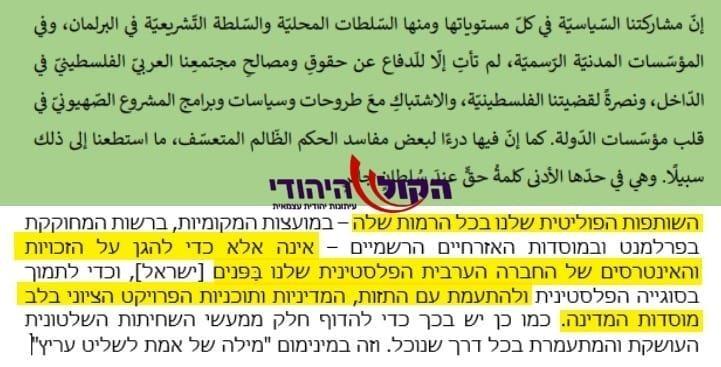
At the core of the charter's strategy lies a specific concept of "Muwatanah" [citizenship]—utilizing civil rights rhetoric and tools while stressing that: "Our political partnership at all levels—in local councils, in the parliament, and in official civil institutions—is solely to defend the rights and interests of our Arab-Palestinian society in the inside [inside Israel], and to support the Palestinian cause and confront the theses, policies, and plans of the Zionist project within the state institutions."
"The incomplete Muwatanah [citizenship] that Israel forced upon the native Arab Palestinian people who remained on their land and in their homeland is an essential and necessary tool... through which we express our national, civil, and religious rights, as a native society living in its homeland with no other homeland... until achieving full Muwatanah rights on the level of national, civil, and religious rights inside Israel, the establishment of the Palestinian state in the West Bank and Gaza Strip with its capital in blessed Jerusalem, and the return of refugees and displaced persons," the charter dictates.
In a 2020 Knesset discussion regarding planning in the Arab sector, Mansour Abbas himself explicitly called to adopt Khamaisi's plans as a strategic framework for the State of Israel.
The ideas mapped out by Khamaisi did not remain confined to theoretical documents; they are being actively translated into concrete action. Khamaisi himself is involved in dozens of planning initiatives—both inside the Green Line and across Judea and Samaria—designed to serve as part of the "Ribat": the struggle over Arab existence and entrenchment on the land, as well as sprawling territorial expansion.
Numerous additional moves have been executed in the spirit of his doctrine, which has been internalized within state systems or advanced by his many disciples.
TAMA 35—the "Integrated National Master Plan for Building, Development, and Conservation"—is the master plan designed to define planning policy and settlement distribution across Israel. Published in 2000 and approved by the government in 2005, it serves as a legally binding statutory document that directs the national spatial footprint. It defines the hierarchy of localities, development boundaries ("blue lines"), designated development zones versus open spaces, and ecological corridors.
Its objective is to concentrate and densify development around transportation and employment hubs, curb suburban sprawl, and protect landscape and natural resources. Regional and local plans must derive from its principles and align with its land designations. TAMA 35 is effectively Israel’s spatial constitution: every regional or local plan must conform to it, meaning even a minor alteration can shift densities, land values, and timelines for decades to come.
Khamaisi participated in drafting the Policy Measures volume of TAMA 35, authoring Chapter 7.10 on the development of Arab localities.
The core principles presented by Khamaisi target the expansion of municipal boundaries for Arab localities, the authorization and legal recognition of as many Bedouin outposts in the Negev as possible, governmental support and subsidies for "traditional" Arab agriculture, and the restoration and preservation of Arab Waqf assets.
Embedded within this chapter is a binding directive: for all planning on private land (which accounts for virtually all Arab localities), the total number of housing units must be calculated based on an anticipated realization rate ("realization factor"). The practical implication is stark: if a given Arab locality requires 1,000 housing units, planners are instructed not to plan for 1,000 units. Instead, they factor in a projected implementation percentage under the premise that on private land, there is no guarantee that every landowner will actually build. Real demand driving actual construction is dismissed as an unreliable assumption. If, for example, the assumed realization rate is set at 40%, planners design for 2,500 housing units so that the 40% actually built yields the target 1,000. This single mechanism multiplies the housing unit count in every master plan by a factor of two to four.
An investigation by the "Arzeinu" organization uncovered how Arab local authorities have systematically exploited this clause over the years—distorting and inflating population figures in their localities to advance gargantuan master plans that consume the lands of the Galilee at a dizzying pace.
Excerpts from the implementation chapter of TAMA 35 for Arab society, authored by Khamaisi, categorized by topic:
Affirmative Action: "The vast disparities existing today between the two populations necessitate a shift in approach toward the development of Arab localities through initiating a proactive process of 'affirmative action.'"
Galilee, Negev, and Jerusalem: "The scope of land designated for development and recommendations for allocating state budget resources for physical infrastructure and human capital are all grounded in granting regional priority to the Galilee, the Negev, and Jerusalem—regions where the majority of the Arab population is concentrated."
Legalization of Bedouin Outposts: "With the goal of advancing a solution to the problem of unauthorized settlement in the Beersheba sub-district, the plan proposes the legalization of Bedouin settlement in the Negev within existing and new localities in this sub-district."
"Realization of Realistic Capacity": "When determining land designations, plot sizes, and density factors in the master plan, a realization factor for realistic housing capacity shall be taken into account, considering the size of the locality, private land ownership, housing supply mechanisms, and their character."
Arab Heritage and Religious Sites: "A comprehensive survey must be conducted encompassing sites of cultural, historical, and religious significance for the Arab population across the country, with actions taken toward their restoration and upkeep as publicly accessible sites while safeguarding their character and sanctity."
In 2019, Khamaisi published a book titled "Planning and Development of Arab Localities in Israel – A New Concept for Local Authority and State Preparedness." The book was published in collaboration with the INSS and the Steinmetz Center for Peace Research at Tel Aviv University, the Israel Democracy Institute and the Jewish-Arab Center (JAC) at the University of Haifa.
The book, geared toward a Jewish readership, employs civil rights terminology of integration and equality, offering explanations regarding a "trust deficit" to justify the need for privileged, unique treatment of Arab localities.
In this work, Khamaisi calls for a change in state authorities' approach to planning in Arab localities—citing, for example, the delegation of planning powers directly to Arab municipalities while "assigning lesser importance to territorial considerations."
Khamaisi insists that this is insufficient, demanding that a "tailored strategy" be designed specifically for the Arab public in Israel. Among his key points, he calls for amending and expanding the municipal boundaries of Arab local authorities based on what Arabs term "village lands"—the territory over which the village claims ownership according to administrative borders predating the establishment of the state.
Khamaisi proposes "establishing planning principles that take into account the cultural, structural, and administrative conditions existing within Arab local authorities." Under this guise, for instance, he seeks to further dilute required housing density.
Khamaisi even calls on the state to settle ownership disputes within the Arab society "while recognizing the rights of citizens who hold ownership by virtue of prevailing custom in their localities"—a policy engineered to directly inflate the physical footprint of Arab localities even further.
To obscure his true motives, Khamaisi engages in a convoluted, quasi-postmodern syntax throughout the book, relying heavily on academic jargon. Consider this sentence from the text: "The complex Israeli reality over these three decades has generated a collage-like state, requiring the construction of a new theoretical infrastructure to frame the contemporary planning system and decipher its nature, as the discipline with its positivist conceptual foundation, developed as part of the modern Western epistemological base, has begun to fracture."
Naturally, Khamaisi harnesses this pretentious obfuscation to rationalize demands for transferring land to the jurisdiction of Arab local councils, transferring planning authority from regional committees directly to Arab localities, allocating state lands to Arab localities (despite no shortage of private land), easing tax and registration requirements for Arabs so that dubious ownership claims do not delay construction, lifting building restrictions, retroactively legalizing or halting enforcement against illegal construction, fast-tracking building plan approvals, and lowering density thresholds (=permitting Arab localities to sprawl across significantly more land per resident than any Jewish locality would ever receive).
An analysis of the planning schemes advanced in recent years as a direct result of the agenda mapped out by Khamaisi reveals a dangerous trend: the emergence of contiguous swaths of Arab territory across the heart of the Galilee, the strangulation of Jewish communities established specifically to serve as strategic 'wedges' in the region, and Arab dominance over main highways.
According to data compiled by the "Lev B'Galil" organization, these master plans forge several contiguous built-up corridors that function as strategic buffers:
Nazareth – Reineh – Mashhad – Kafr Kanna – Tur'an: 10.5 km (6.5 miles)
Sakhnin – Arrabah – Deir Hanna – Eilabun: 10 km (6.2 miles)
Shefa-'Amr – I'billin – Tamra – Kabul: 11 km (6.8 miles)
Majd al-Krum – Deir al-Asad – Bi'ina – Nahf: 10 km (6.2 miles)
To illustrate the scale, these contiguous built-up corridors match or exceed the distance from the Tel Aviv coastline to Petah Tikva.
Clearing JNF Forests to Expand a Hostile Galilee Village
The physical expansion of Arab localities manifests in several ways, most notably through petitions for boundary adjustments and municipal expansion. The creation of the National Committee for Preferred Housing Schemes (VATMAL) opened a "bypass track": after advancing a construction plan that disregards existing municipal boundaries, local authorities subsequently submit requests to revise boundaries under the umbrella of comprehensive master plans.
As an advisor to local councils and an active planner, Khamaisi has been involved in dozens of planning schemes. Some entail expanding municipal boundaries for Arab authorities or reallocating tax revenues from Jewish to Arab councils, while the vast majority are residential construction plans. His conduct before official state planning authorities is far more cautious and discreet than his rhetoric before anti-Israel audiences.
Here are several examples of plans Khamaisi has advanced or attempted to advance:
Kafr Kanna: Khamaisi resides in Kafr Kanna, a primary stronghold of the Islamic Movement in the Galilee and home to Kamal Khatib, deputy chairman of the movement's Northern Branch. In recent years, the Northern District Planning and Building Committee approved massive master plans for Kafr Kanna that will effectively triple the size of the locality. While the village currently houses 25,000 residents, the approved comprehensive master plan is engineered for a target capacity of 76,000. Based on this master plan, five detailed plans encompassing thousands of residential housing units have already been approved. The plan includes a massive structural rezoning to add entire residential neighborhoods—expanding eastward toward Ein Mahil (effectively encircling Har Yona in Nof HaGalil) and northward toward Highway 77 leading to the Beit Rimon junction, creating physical continuity with Tur'an. These schemes drive a dramatic expansion of over 50% in Kafr Kanna's development footprint, rezoning State land, with the crowning jewel being a plan that expands the village directly onto Highway 77 by cutting down a JNF forest (part of the Beit Keshet Forest).
To grasp the absurdity, one must recall the violent events of Operation Guardians of the Walls in May 2021, when rioters from the village hurled stones and fired live ammunition at police officers. In the aftermath, the IDF established Home Front Command brigades specifically tasked with clearing vital transport arteries during wartime. Yet with the other hand, the state approved the expansion of one of the most hostile villages in the Galilee directly towards a major road junction on Highway 77.
Furthermore, the sprawling development of Kafr Kanna is creating an Arab metropolis spanning the entire Nazareth range, encircling Nof HaGalil: starting from Tur'an, sweeping through Kafr Kanna to Ein Mahil, Iksal, and Daburiyya in the east; and through Mashhad and Reineh toward Nazareth in the west. To the south lies a nearly uninhabited corridor stretching roughly 13 km (8 miles) west of Afula, providing open access to the Jenin area—which can be reached within minutes.
All of this unfolds while the primary Jewish community on Highway 77—Mitzpe Hoshaya—faces severe bureaucratic hurdles imposed by the Israel Land Authority, remaining stagnant and even shrinking over the past five years.
Deir al-Asad: In Deir al-Asad, Khamaisi participated in advancing a comprehensive master plan designed to de-allocate land from Moshav Lapidot—a scheme exposed by Hakol HaYehudi. In this plan, the population growth projection through 2040 was inflated by at least a factor of 2.55, while an assumed realization factor of roughly 48% multiplied the target figure again by 2.08. The result: authorization for a housing unit quota at least 5.3 times greater than required. After the plan was deposited and the land grab for expansive construction appeared secured, the local council—with Rassem Khamaisi serving as advisor—submitted a formal objection proposing to slash the required building density by 30%, dropping it from ten housing units per dunam down to just seven.
Arrabah: The comprehensive master plan for Arrabah creates a contiguous territorial belt in the Misgav region across three major localities: Deir Hanna, Sakhnin, and Arrabah. In May 2019, a land-transfer agreement was signed between the Misgav Regional Council and the city of Arrabah. Khamaisi was photographed during the signing of the agreement, which was framed as a compromise to facilitate the comprehensive master plan expanding Arrabah's boundaries. In Arrabah's master plan, the residential line stretches along Highway 7955 for over half a kilometer, just 70–80 meters (230–260 feet) from the road—which serves as the sole access route for the Jewish communities of Avtalion and Hararit.
Notable examples of additional plans that were either blocked or only partially advanced include:
Kaukab Abu al-Hijaa: In 2005, Khamaisi submitted a request to expand the municipal area of the Kaukab Abu al-Hijaa council northward and southward. Had the plan been approved and executed, the village—currently situated south of Highway 784—would have straddled both sides of the primary access road for the Misgav Jewish communities.
Judeideh-Makr: As early as 2009, Khamaisi promoted a plan to build a new Arab city south of Judeideh-Makr on Highway 85, the primary east-west arterial highway of the Galilee. While initially blocked, the plan was ultimately pushed through via the accelerated VATMAL track as urban neighborhoods of Judeideh-Makr.
Sakhnin: In 2020, Khamaisi represented the Sakhnin Municipality in a plan to expand the city so that it would envelop the Jewish community of Eshbal on three sides. Following public exposure and heightened awareness of the strategic risk, the plan was halted—for the time being.
While Khamaisi's plans for massive Arab territorial expansion via the manipulation of planning rules have largely enjoyed cooperation from state planning bodies, his methods were occasionally found unacceptable even for official planners. During deliberations on an Eilabun council plan to expand onto JNF lands toward Highway 65, the Northern District Planner wrote regarding an environmental impact statement prepared by Prof. Rassem Khamaisi: "Significant flaws were found regarding the gross overestimation of anticipated population size."
When observing Khamaisi's maneuvers across Judea and Samaria, it is impossible not to recognize them as part and parcel of the Palestinian Authority's strategic blueprint to grab territory and construct a de facto state.
When observing the strategy he engineered and its tangible yields in the Galilee, the conclusion is inescapable: it shares the exact same objective—except here, the agent executing the Arab land grab is the State of Israel itself.
This begs a critical question: Where were the planning authorities and official committees? Did no one notice? Did no one attempt to halt it?
The systemic shifts detailed above—such as the legacy of the Or Commission—coupled with near total domination of the planning establishment by the left and the radical left, served to suppress and neutralize virtually any voice attempting to raise alarms regarding the emerging trend.
"The State of Israel negligently enabled the promotion of a 'Fayyad Plan-North' by approving a succession of master plans that directly undermine Israeli sovereignty in the Galilee," warns Ofir Schik, Chairman of the Lev B'Galil organization and Deputy Head of the Lower Galilee Regional Council.
Schik recalls encountering Khamaisi at numerous junctures within Northern planning proceedings. "I crossed paths with Khamaisi at key points in the Northern planning arena—for example, when he arrived to represent Tur'an in their opposition to establishing the new Jewish community of Shibbolet, claiming it stifled their growth, despite a 3-kilometer gap and a sheer cliff separating the two."
Schik asserts that the findings of this investigation demand immediate government intervention: "There must be an order for a comprehensive retroactive review to rectify these delusional approved plans, forcing them to rely on realistic CBS [Central Bureau of Statistics] data and strict density mandates—the exact same requirements imposed on every Jewish locality. In light of the May 2021 riots and basic common sense, it is imperative to mandate a security assessment for every plan, particularly those impacting strategic transportation arteries."
Jonathan Achiya, CEO of the Artzeinu organization—which has focused extensively on Galilee planning developments in recent years—is equally unequivocal: "This is a deliberate, calculated effort. The master scheme engineered by Khamaisi and his associates in the Galilee completely dwarfs the Fayyad Plan unfolding in Judea and Samaria."
"They advance plans across three or four tracks simultaneously; they possess complete mastery and understanding of every nuance in the planning process. While we wage a public battle against, say, the wildly exaggerated expansion of Ilut that tramples over Giv'at Ela—at that exact moment, at least 70 to 80 other plans spanning roughly 30 different localities are quietly moving forward."
"They are playing against an undefended goal—proven by the fact that over the past four years alone, they expanded the development footprint across more than 40 localities by anywhere from 30% to 100%."
"The sheer volume of housing units planned for the Arab sector in the Galilee is zoned to accommodate over half a million people. If we open our eyes for a moment, we realize they are laying the regulatory and physical infrastructure for the actual implementation of the 'Right of Return'—all funded and sanctioned by the State of Israel. The Ministry of Defense must step into the picture immediately, because this is a first-rate strategic security threat."
Achiya likewise demands that the government intervene and freeze the process: "All pending plans must be halted immediately until a rigorous audit of the distorted data is conducted. In Kafr Qara, for instance, a plan is currently being pushed based on a fabricated population forecast of 90,000 residents. On the back of this fiction, they are planning 11,000 housing units and legalizing 750 illegal structures. This is nothing short of a fire sale of our homeland's land reserves."
Editor's Note: A series of detailed questions was submitted to Prof. Rassem Khamaisi prior to publication. Khamaisi chose not to respond to the queries, claiming they constituted accusations rather than questions. His response will be published if received.